I made this post as the President of my University’s Nursing Society a few years ago (cringeee) but I still think that it is quite relevant so here you go:
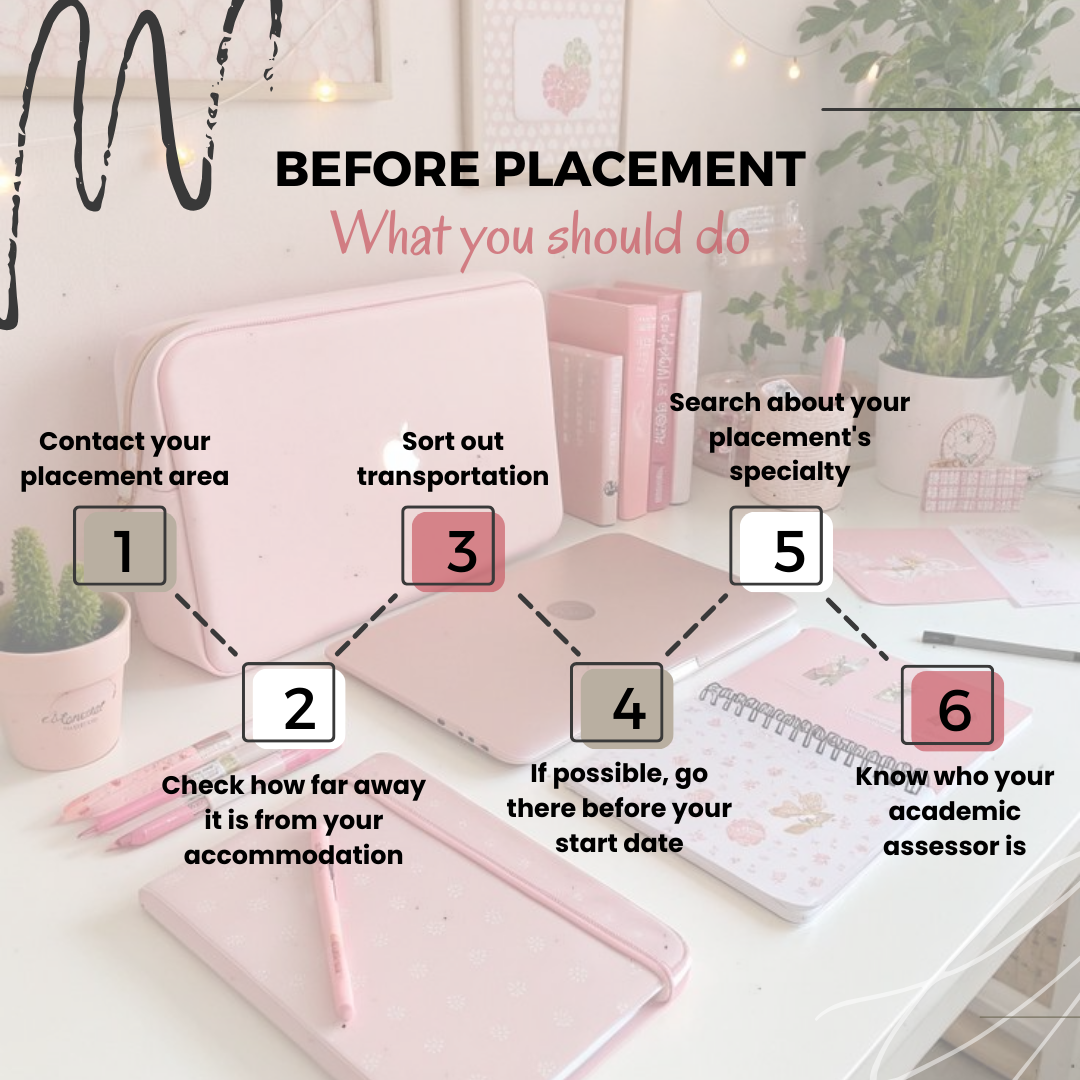
1. Contact your placement area
Although it is up to you when you should contact your placement, it is by far the most important step. Some people choose to do it almost one month in advance while others just a few days before they start. Our advice is that you should contact them not too soon, not too late. This being said, 1-2 weeks prior should be just fine.
By contacting your clinical area, you should try to find out what day you’re starting, shift patterns and, if they have the information and who your practice assessor is as they will be the person responsible for you on placement and for assessing most of your practical skills, knowledge, attitudes and values.
One model you might want to try following is this one:
“Hi, my name is Susan. I am a 1st year student nurse and I am starting my placement on your area in 2 weeks. Is there anyone I can speak with regarding this?”
Use this opportunity to arrange a visit as discussed in Step 4.
2. Check how far your placement is from your accommodation
Unfortunately you will not always be placed on the closest area to where you live so you should be expecting to be placed anywhere. You can check the distance by using Google Maps so you can have an idea of what kind of transport will be the most suitable for you.
3. Sort out transportation
Now that you know how far your placement is from you, it is time to know how’re getting there.
Are you catching the bus? Are you driving there? How much is parking? Do you know anyone who is also placed in the same area as you. If so, can they drive you there or would you rather share an uber?
For those eligible, please check with your university to see if you can claim back your travel expenses at the end of your placement!
4. If possible, go to placement before your start date
Doing this will allow you to test your transportation method. You’ll be able to familiarise yourself with the bus stops, check if there is parking available outside the facility (hospital, clinic etc), or, if you manage to park inside, you’ll get to know if it is normally busy and how much the tickets are. Maybe you’ll realise that it is better for you to take an earlier bus.
5. Search about your placement’s specialty
As I mentioned on a previous post where I talked about the best tips for students on placement, searching about the specialty of your clinical area will 100% work in your favour. You don’t want to go to a neurosurgery ward not knowing anything about the neurological system and when nurses ask you basic questions, you don’t know. Mind you, I am not saying that not knowing things is bad. For the contrary. Not knowing things encourages us to go above and beyond to find answers to our questions and that’s why the world, including healthcare, is as advanced as it ever has. That said, the least you can do and are expected to do, is doing your research and educate yourself. Placements are an excellent way for you to learn but they won’t be enough. Some unis have placements that are 3-4 weeks long and if you want to take the most out of them, you have to do some independent reading. Therefore, if you go to a neurosurgery ward, here are some questions that you might want to search:
1. What is neurosurgery?
2. What is the neurological system and how does it work?
3. Why do patients have brain or spinal surgeries?
4. What is the role of a neurosurgery nurse?
5. What are some of the most common medications neurosurgery patients take?
6. What are some of the short and long term effects of neurosurgery patients?
These questions will make you ask more questions and so on. That is the beauty of not wanting to settle for what you know.
6. Know who your academic assessor is
According to the NMC (2018), your academic assessor will work with your practice assessor to make a recommendation for your progression. The two assessors must take this decision collaboratively, taking into consideration your learning and achievement across theory and practice. Essentially, while your practice assessor is the person responsible for you in practice, your academic assessor will be responsible for you at uni. Your academic assessor will then review your assessments and confirm whether you have achieved the proficiencies and programme outcomes set in the academic and practice environment for each part of the course.
References
NMC. (2018). What do academic assessors do?. What do academic assessors do? – The Nursing and Midwifery Council